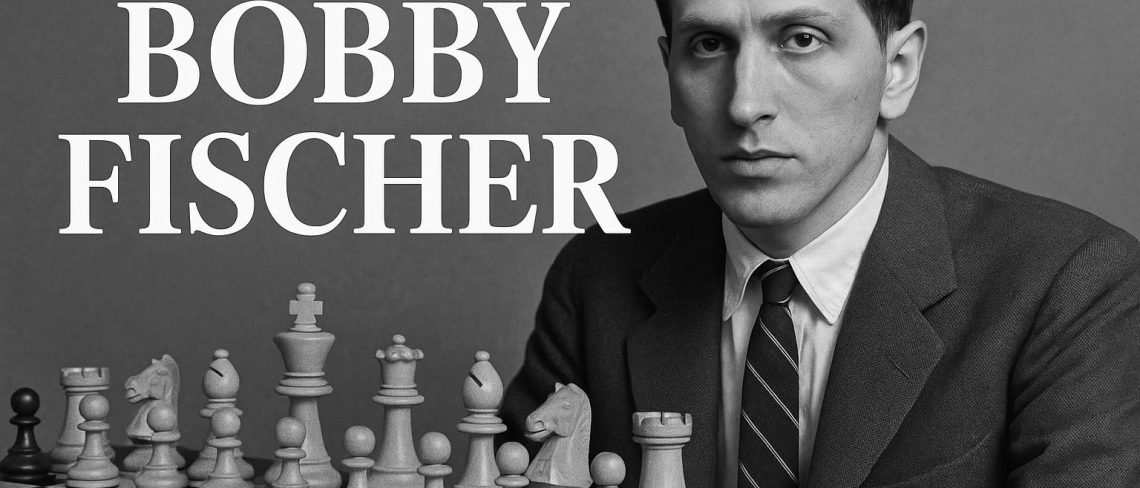
The Genius of Bobby Fischer
Bobby Fischer is consistently celebrated as one of the most remarkable talents in the history of chess. His contributions to the game are both profound and far-reaching, leaving an indelible mark on the chess world. Born on March 9, 1943, in Chicago, Illinois, Fischer’s exceptional skills in chess were evident even during his formative years. His unmatched ability to conceptualize complex positions and calculate them with extraordinary precision distinguished him from his contemporaries, marking him as a formidable force in the chess community.
Early Life and Ascendancy in Chess
Fischer’s journey with chess began quite serendipitously when he received a chess set as a gift at the tender age of six. This simple gift ignited a passion in Fischer that would go on to define his life and career. By the age of 13, Fischer had already made a significant impression on the chess world with his stunning performance in a match against Donald Byrne. This game, famously referred to as “The Game of the Century,” showcased Fischer’s extraordinary strategic vision and tactical acumen, heralding his potential to reshape the sport. It was clear from this early stage that Fischer possessed a rare genius, one that would propel him to the upper echelons of chess.
Fischer’s Impact on Chess Theory
Fischer’s influence on chess theory is profound and enduring. He was renowned for his meticulous dedication to the game, constantly striving to push the boundaries of what was possible in chess. Fischer introduced several significant innovations in chess opening strategies, particularly in the Sicilian Defense and the King’s Indian Defense. These contributions continue to be studied and analyzed by players worldwide. His unyielding perfectionism and insistence on precise play were catalysts for pushing competitors to elevate their standards. Fischer’s approach to the game was characterized by an obsession with accuracy and an acute attention to detail, challenging existing norms and inspiring a new level of rigor in chess strategy.
The 1972 World Chess Championship
Fischer’s undoubted genius was perhaps most prominently displayed during the 1972 World Chess Championship. In this highly anticipated match, Fischer faced Boris Spassky of the Soviet Union. The championship took place during a period of intense geopolitical tension, and the match became emblematic of the Cold War, transforming a chess event into a cultural and ideological confrontation. Fischer’s victory not only made him the first American-born World Chess Champion but also catapulted chess into the spotlight in the United States, sparking widespread interest and enthusiasm for the game. This moment was pivotal in popularizing chess in America, and Fischer’s triumph remains a seminal event in chess history.
Legacy and Influence
Despite the volatility and challenges that marked Fischer’s career, his contributions to chess are enduring and continue to influence countless generations of chess enthusiasts. Fischer’s relentless pursuit of perfection, along with his disregard for conventional norms, fundamentally challenged the established practices of chess play and organization. Among his notable contributions were the introduction of a new chess clock, known as the Fischer clock, designed to improve the timing control for players. Furthermore, Fischer advocated for a new variant of chess called Fischer Random Chess, or Chess960. This variant randomized the starting positions of the pieces, encouraging creativity and reducing the emphasis on rote memorization, thereby fostering a more dynamic and unpredictable form of the game.
Fischer’s life, rich with both remarkable achievements and personal challenges, remains a compelling narrative in the annals of chess. His genius was unmistakable, as was his ability to transform the landscape of chess dramatically and instill a profound appreciation for the game’s complexities. His influence extends far beyond his own era, as players and enthusiasts continue to draw inspiration from his innovative approaches and profound understanding of chess.
For those interested in further exploring Fischer’s enduring impact on chess, numerous resources and analyses are available through various archives and scholarly examinations of his games. Many of these resources, including detailed analyses and historical records, can be accessed through platforms such as Chess.com and other specialized chess websites. These platforms offer invaluable insights into Fischer’s strategies, innovations, and lasting legacy, providing an opportunity for chess enthusiasts to appreciate the depth and breadth of his contributions to the world of chess.