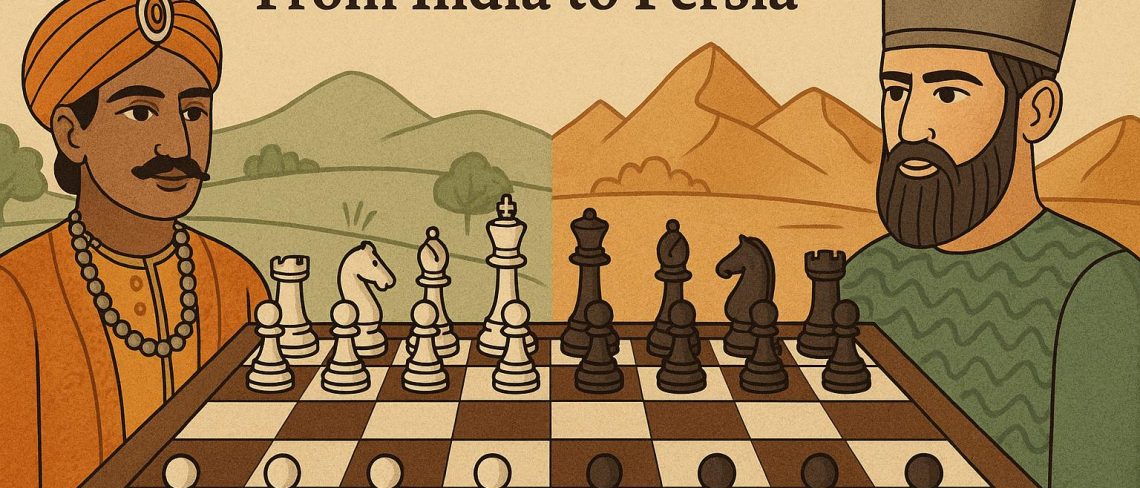
The Origins of Chess: From India to Persia
The game of chess, renowned for its strategic depth and rich history, traces its origins back to ancient India. Known as Chaturanga, the early version of chess was a four-player war game representing the four divisions of the Indian army: infantry, cavalry, elephants, and chariotry. This early game set the foundation for modern chess with its checkered board, strategic movements, and tactical objectives.
Development of Chaturanga in India
Chaturanga, emerging around the 6th century AD, is considered the first representation of a game featuring mechanisms that resemble those of contemporary chess. The name itself relates to a battle formation mentioned in the Indian epic Mahabharata, demonstrating the game’s deep cultural and historical roots. Typically played on an 8×8 grid, Chaturanga’s focus on capturing the opponent’s king mirrors today’s chess objective.
Rules and Mechanics
In Chaturanga, players controlled a set of pieces with defined movements, much like modern chess pieces. The infantry, akin to pawns, advanced a step at a time. The cavalry, elephants, and chariots had unique directional abilities, drawing parallels to knights, bishops, and rooks, respectively. The victory condition was to capture the opponent’s king, similar to delivering checkmate today. The game’s strategic depth was apparent even in these early rules, as coordination among pieces was essential to achieve victory.
Introduction to Persia
The migration of chess to Persia marked a significant milestone in the game’s evolution. It was during the Sassanian Empire that Chaturanga made its way to Persian society, where it was embraced with enthusiasm. The game was known as Shatranj in Persian culture, and major transformations began to take shape, which would influence the way chess spread across the world.
Modifications and Cultural Impact
In Persia, certain modifications were made to the rules and aesthetics of the game. The pieces were given new names: the infantry became peons, the cavalry became asbs (knights), and the elephants were referred to as fil (bishop). These changes not only adjusted the gameplay but also ingrained the game deeply into Persian storytelling, literature, and culture. Chess became a medium to display wit and skill, fostering intellectual discussions and competitions. The Persian adaptation added a layer of narrative and challenge that adapted to the aesthetic and intellect of Persian society.
Shatranj in Persian Society
Chess, or Shatranj, became a favorite pastime among the Persian nobility and was often seen as an intellectual pursuit that demonstrated one’s strategic acumen. The Sassanian nobles engaged in chess as a way to refine their strategic thinking and decision-making capabilities, which had applications beyond entertainment. Chess played a role in diplomatic interactions, offering a non-violent contest of intelligence and perceptiveness. Persian poets and scholars often included chess in their works, using it as a metaphor for life’s complexities and the battles of wits within social and political arenas.
Historical Records and Evolution
Some of the earliest recorded chess games come from Shatranj matches preserved in Persian manuscripts. These records highlight not only the strategic considerations of the time but also the cultural importance assigned to the game. Chess variant strategies were meticulously documented, offering insights into the evolution of strategic thought processes over the years. This preservation allowed successive generations to study and build upon earlier strategic concepts, leading to the continuous development of the game’s complexity.
Conclusion
The transmission of chess from India to Persia illustrates a fascinating journey of cultural exchange and transformation. As chess evolved through these regions, it not only retained its original strategic essence but also welcomed innovations that crafted its current identity. The interplay between Chaturanga and Shatranj is a testament to the game’s enduring appeal and intellectual richness, a testament that can still be observed in the global popularity of chess today. Chess, through its rich historical development, highlights an intriguing narrative of adaptation and cultural symbiosis.
The Legacy and Future of Chess
Understanding the origins of chess sheds light on its modern variations and the untapped potential for further transformation. Although originating as a game reflecting military tactics and power strategies, chess today serves as a universal language of strategy and intellectual engagement across cultures. Its journey from ancient India to Persia, and subsequently across the globe, exemplifies the potential for games and cultural phenomena to transcend borders, influencing societies in unexpected and enriching ways.